In healthcare and medical training, staying compliant and up-to-date is non-negotiable. But for many small to mid-sized medical companies, traditional Learning Management Systems (LMS) just don’t cut it.
What is an LMS?
A Learning Management System (LMS) is a digital platform designed to manage, deliver, and track training or educational content. It’s used by organizations to onboard employees, deliver compliance training, offer continuing education, or run certification programs.
For example:
- A growing medical practice tries to customize their LMS for HIPAA training but finds the platform too rigid.
- A medical device company struggles to integrate training materials into its existing workflow and software tools.
- A biotech startup faces steep licensing fees and long setup times—just to deliver basic onboarding.
While these platforms work well for larger enterprises or academic institutions, they often lack the agility, customization, and affordability that small to mid-sized medical companies need.
While LMS platforms are meant to support training and compliance, the reality is that most were built for large enterprises—with big budgets, generic workflows, and one-size-fits-all approaches. That leaves growing medical teams stuck with expensive, rigid systems that simply don’t fit their needs.
Let’s break down why traditional LMS platforms often fall short—and what kind of solution medical companies should look for instead.
1. High Cost, Low Return
One of the biggest barriers is price. Traditional LMS platforms often come with:
- Steep licensing fees
- Costly customizations
- Ongoing support and maintenance charges
For small to mid-sized companies, that’s a heavy lift—especially when the ROI isn’t immediate or measurable. You shouldn’t need an enterprise budget to deliver effective training.
2. Poor Customization and Fit
Medical companies often need specialized training workflows, industry-specific content (like interactive anatomy diagrams or drug information), and integration with tools like:
- Electronic health records (EHRs)
- Compliance systems
- Medical device interfaces
Most traditional LMS platforms offer limited flexibility when it comes to branding, structure, and user journeys—making it difficult to adapt to the nuances of medical education.
3. Integration Challenges
A disconnected tech stack leads to inefficiencies.
Smaller medical organizations rely on multiple platforms—practice management software, scheduling tools, compliance trackers, etc. When a traditional LMS can’t integrate with these, it creates:
- Data silos
- Manual workarounds
- Missed opportunities to automate reporting and tracking
What’s needed is seamless integration that actually supports your workflow.
4. Not Optimized for Medical Content
Surgical procedures, clinical simulations, or animated drug mechanisms require more than a slideshow. Unfortunately, many LMS platforms were never built to handle rich media, step-by-step clinical visuals, or patient-facing educational tools.
The result? Dry, disengaging content that doesn’t stick.
5. Lack of Hands-On Support
Small teams don’t have the luxury of an in-house LMS administrator. But traditional platforms often provide minimal onboarding, limited content development help, and long wait times for support.
You’re left juggling multiple hats—and wasting time managing a system that was supposed to make your life easier.
6. Limited Scalability
Even if a traditional LMS works for you now, it might not later.
Many smaller medical companies experience growing pains with outdated platforms that can’t scale easily—or force expensive reconfigurations to accommodate a growing team or new training needs.
7. Poor User Experience
Let’s be honest—many LMS platforms are clunky and confusing. Medical professionals are busy, and they don’t have time to struggle with navigation, broken links, or confusing modules.
If training isn’t intuitive, it won’t be effective.
The Bottom Line:
Traditional LMS platforms may work for large institutions, but they’re often a mismatch for small to mid-sized medical companies. Between cost, complexity, and lack of medical-specific features, these systems can actually slow down progress instead of driving it.
What Should You Look for Instead?
Look for a solution that is:
- Flexible and customizable for your workflows
- Cost-effective with transparent pricing
- Integrated with your existing tools and software
- Optimized for rich medical content and learning formats
- Supported by a team that understands your industry
- Scalable and intuitive—so it grows as you grow
Why V-Unite Works for Medical Teams
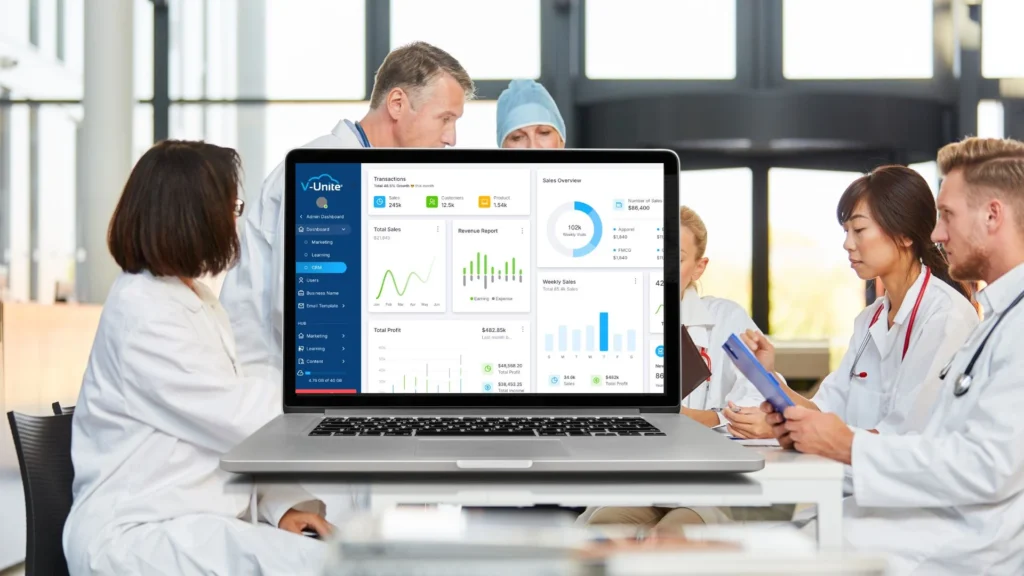
Unlike traditional LMS platforms, V-Unite is designed for immersive engagement—turning static training into interactive, on-brand, and trackable learning experiences. With drag-and-drop tools, analytics dashboards, compliance-ready features, and 24/7 support, we help medical teams create results-driven onboarding, education, and ongoing training without the LMS headache.
Book a free demo today and see how V-Unite transforms learning into lasting performance.